
We pour them to replace broken-up old drives, to put a first hard surface on a bare lot, and to widen or reshape where the cars go.
How do you know the driveway needs replacing, not patching?
Replace the driveway when the slab is broken across its width, sunken in places, or sending water toward the house, because patching does not fix those. Concrete Group of Lakeland looks at the whole surface in Lakeland before recommending either route, since a few hairline cracks are a different problem from a slab that has moved.
The signs we look for: cracks wide enough to catch a fingernail, sections sitting higher or lower than their neighbors, chunks missing at the edges, and puddles that sit after rain instead of draining off. Standing water is the one we weigh most. Water that stands on a driveway or runs toward the garage points to a grading problem, and a new surface laid on the same grade just repeats it.
New installs are the other case. Gravel or bare dirt where a driveway should be, or an old slab too small for the vehicles you own, usually means starting from forms and a fresh base.
Many projects also need concrete patio installation. Shopping for a concrete contractor in Lakeland? Our home page has more.
More answers: What Happens During Concrete Work: The Steps Explained · Comparing Concrete Work Quotes: What Is Worth Checking
What does a new concrete driveway cost?
Broom-finish concrete driveways in Lakeland run $7 to $11 per square foot, and if you phone Concrete Group of Lakeland we will give you that ballpark right then. We firm up the figure at your site, where size, shape and the amount of prep the ground needs settle where in the range you land.
Price climbs with a bigger footprint, curves and odd shapes that take more forming, demolition of the old slab, and ground that needs extra work before the pour. What pulls it down: a simple rectangle, a clear site, and a base that is already in decent shape.
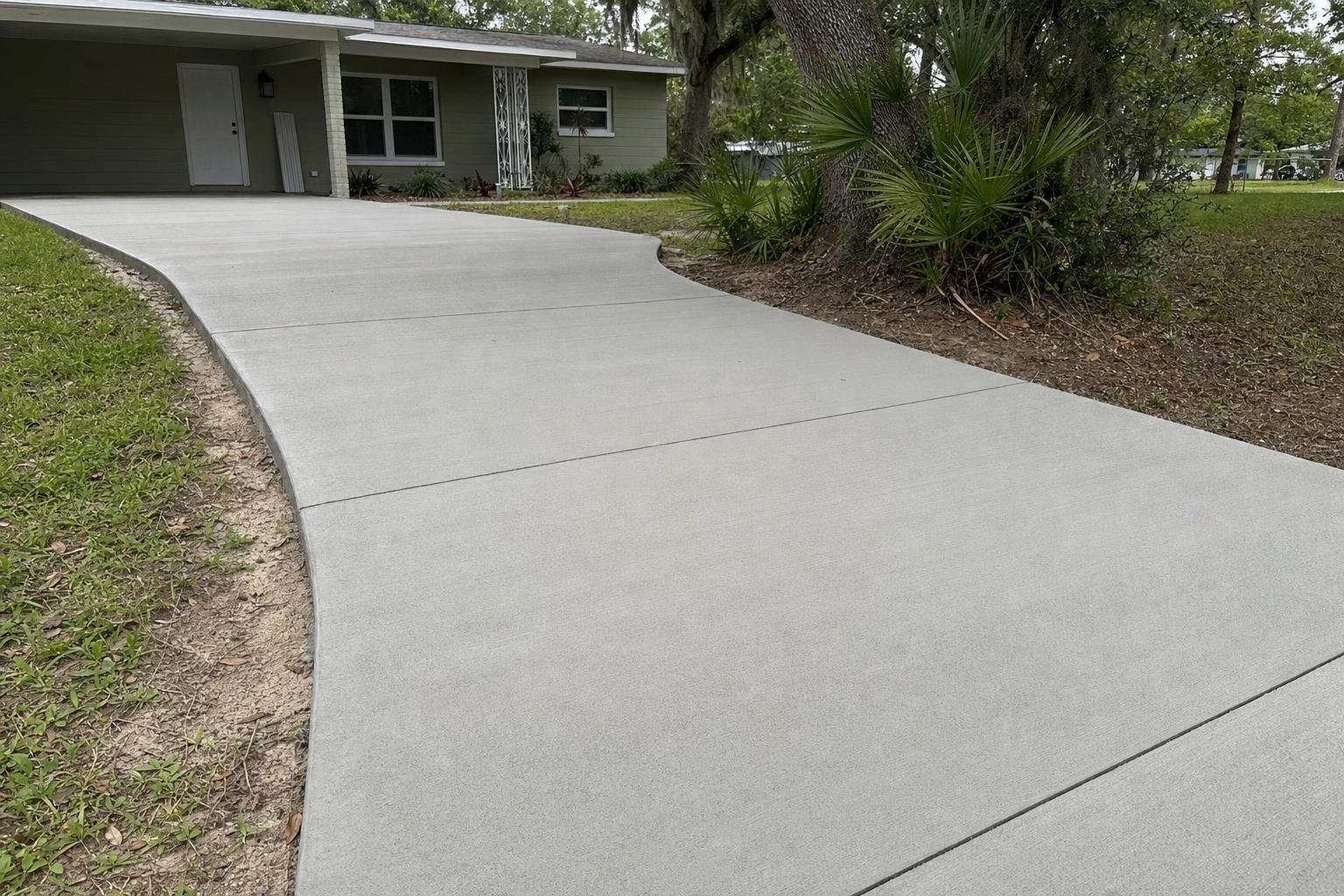
How is the driveway built, start to finish?
A driveway goes in as forming, mesh, placing, screeding, floating, and brooming, in that order. Concrete Group of Lakeland sets wood or metal forms, lays welded-wire mesh, places the concrete, screeds it level to the required thickness, bull-floats it, and brooms once the bleed water has dissipated.
The forms hold the edges and set the slab thickness. The mesh goes in before the pour so it ends up inside the slab, not lying under it. We place the concrete evenly into the forms so the thickness stays consistent across the whole surface.
The bull float smooths and settles the top. Then we wait. Bleed water is the thin film that rises to the surface, and we do not broom until it is gone. Once it has, the broom texture goes on, and that texture is what gives the driveway grip when it is wet.
How long does the job take?
Four things set the schedule: the driveway's size, how much old material is coming out, the prep the ground needs, and the weather. Concrete Group of Lakeland gives you a start date and duration after walking your Lakeland site, since those factors differ from one job to the next.
The pour and finish happen in a single stretch, and the length of that day follows the square footage. Forming and prep come first and can take longer than the pour itself on a tricky site. After finishing, the slab needs time before it takes traffic, and we tell you when you can walk on it and when the cars can go back.
Weather is the swing factor. A pour day lost to rain gets moved to the next workable day.
How do Lakeland rain and grading affect the driveway?
Lakeland has a heavy summer wet season, and during Hurricane Milton in 2024 parts of the city took more than a foot of rain in a day. Concrete Group of Lakeland grades every driveway so runoff leaves the slab, and schedules earthwork and subgrade prep around the rain where we can.
Subgrade work in heavy rain turns into mud management, which is why we would rather move a day than prep in a downpour. Grading is also where drainage gets decided. We set the fall so water does not collect at the garage or against the house, and that is far cheaper to get right before the pour than to live with afterward.
Light freezes only show up now and then in a Lakeland winter, so a cold-morning pour gets a forecast check, but rain moves our schedule far more often.
Some of the Specifics
In plain terms, the work covers:
- Lay and compact crushed stone as the base, setting its depth to suit the site and soil.
- Install and stake the forms to match the driveway’s planned size, thickness, and slope for drainage away from house and garage.
Other Services We Offer
Typical Lakeland Pricing
The figures here give you a sense of scale, and we put the exact price in writing before any work starts.
$2,450–$13,000
$7–$18 per square foot
$5.50–$7 per square foot
Fast Scheduling
A call is the quickest way to describe it, and you decide what happens next.